
HOW TO CALCULATE THE LOAD ON EACH AXLE BY WEIGHING
- Weigh the front axle with the tool in its working position
- Weigh the rear axle with the tool lifted
- Ballast the front of the tractor to obtain a weight distribution of 35% at the front and 65% at the rear
- Check that the weight obtained complies with the load index of your tyres (see table below)
- Adjust the pressure based on the weight and driving speed
HOW TO CALCULATE THE LOAD ON EACH AXLE WITHOUT WEIGHING
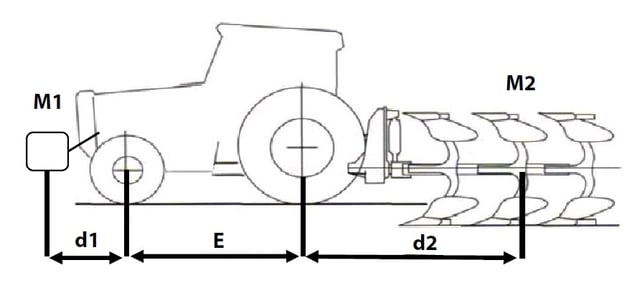
LOAD ON EACH AXLE
If you don’t have any weighing equipment, you can calculate the load on each axle to make sure you’re using the right pressure and that your tyres are protected.
»To do this calculation, you will need to know:
| 1 | Your tractor’s tare weight: read the manufacturer’s information to find the front axle tare weight (FA tw) and the rear axle tare weight (RA tw). |
| 2 | The weight of the rear-mounted tool M2(manufacturer data). |
| 3 | The front ballast weight M1(or front-mounted tool, where applicable). |
»You must then measure:
| 1 | The distance d1between the centre-point of the front ballast weight (or centre-point of the front-mounted tool) and the centre of the front axle. |
| 2 | The distance E between the centre of the front axle and the centre of the rear axle. |
| 3 | The distance d2 between the centre of the rear axle and the centre-point of the rear-mounted tool. |
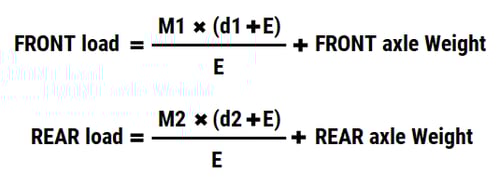
»You can then calculate the weight on each axle:
A TYRE LOAD INDEX OF 171 A8 MEANS A MAXIMUM OF 6150 KG AT 40 KM/H MAX

In the table below you can find the load index that matches the marking on your tractor tyre.
This index tells you the maximum weight your tyre can bear at a given speed.
EQUIVALENCE TABLE FOR WEIGHT IN KG/TRACTOR TYRE LOAD INDEX
The tyre load index (LI) given in the table above is only valid if you stay below the speed code stated in the table below. In the photos for example, “171 A8” only applies to this agricultural tyre if you drive no faster than 40 km/h. Anything over this speed and your tyre will be overloaded, and will wear down very quickly and may even be extremely dangerous at higher speeds.
| I.C. | kg | I.C. | kg | I.C. | kg | I.C. | kg | I.C. | kg |
| 73 | 365 | 74 | 375 | 75 | 387 | 76 | 400 | 77 | 412 |
| 78 | 425 | 79 | 437 | 80 | 450 | 81 | 462 | 82 | 475 |
| 83 | 487 | 84 | 500 | 85 | 515 | 86 | 530 | 87 | 545 |
| 88 | 560 | 89 | 580 | 90 | 600 | 91 | 615 | 92 | 630 |
| 93 | 650 | 94 | 670 | 95 | 690 | 96 | 710 | 97 | 730 |
| 98 | 750 | 99 | 775 | 100 | 800 | 101 | 825 | 102 | 850 |
| 103 | 875 | 104 | 900 | 105 | 925 | 106 | 950 | 107 | 975 |
| 108 | 1 000 | 109 | 1 030 | 110 | 1060 | 111 | 1 090 | 112 | 1 120 |
| 113 | 1 150 | 114 | 1 180 | 115 | 1215 | 116 | 1 250 | 117 | 1 285 |
| 118 | 1 320 | 119 | 1 360 | 120 | 1 400 | 121 | 1 450 | 122 | 1 500 |
| 123 | 1 550 | 124 | 1 600 | 125 | 1 650 | 126 | 1 700 | 127 | 1 750 |
| 128 | 1 800 | 129 | 1 850 | 130 | 1 900 | 131 | 1 950 | 132 | 2 000 |
| 133 | 2 060 | 134 | 2 120 | 135 | 2 180 | 136 | 2 240 | 137 | 2 300 |
| 138 | 2 360 | 139 | 2 430 | 140 | 2 500 | 141 | 2 575 | 142 | 2 650 |
| 143 | 2 725 | 144 | 2 800 | 145 | 2 900 | 146 | 3 000 | 147 | 3 075 |
| 148 | 3 150 | 149 | 3 250 | 150 | 3 350 | 151 | 3 450 | 152 | 3 550 |
| 153 | 3650 | 154 | 3 750 | 155 | 3 875 | 156 | 4 000 | 157 | 4 125 |
| 158 | 4 250 | 159 | 4 375 | 160 | 4 500 | 161 | 4 625 | 162 | 4 750 |
| 163 | 4 875 | 164 | 5 000 | 165 | 5 150 | 166 | 5 300 | 167 | 5 450 |
| 168 | 5 600 | 169 | 5 800 | 170 | 6 000 | 171 | 6 150 | 172 | 6 300 |
| 173 | 6 500 | 174 | 6 700 | 175 | 6 900 | 176 | 7 100 | 177 | 7 300 |
| 178 | 7 500 | 179 | 7 750 | 180 | 8 000 | 181 | 8 250 | 182 | 8 500 |
| 183 | 8 750 | 184 | 9 000 | 185 | 9 250 | 186 | 9 500 | 187 | 9 750 |
| 188 | 10 000 | 189 | 10 300 |
| SPEED CODE | SPEED (km/h) | SPEED CODE | SPEED (km/h) | |
| A1 | 5 | B | 50 | |
| A2 | 10 | C | 60 | |
| A3 | 15 | D | 65 | |
| A4 | 20 | E | 70 | |
| A5 | 25 | F | 80 | |
| A6 | 30 | G | 90 | |
| A7 | 35 | |||
| A8 | 40 |
WHAT TYPE OF TYRE LETS YOU KEEP THE SAME PRESSURE AT ANY SPEED?
Agricultural tyres made using VF technology are the most efficient low-pressure model on the market, enabling you to carry heavier loads with greater resistance per tyre, increase your tractor’s traction capacity, and reduce your fuel consumption.
However, the biggest selling point is their reinforced casing design, which allows them work in fields at a very low pressure (0.8 bar), where the compressed tyres distribute the weight across a greater surface area, preserving your crops and your productivity.
They require no pressure adjustments between roads and fields, and are able to withstand higher road speeds at the same pressure as used in the field, while still offering a comfortable drive.